
Australia’s Circular Economy: Practical steps & Eco Cottages’ prefab model
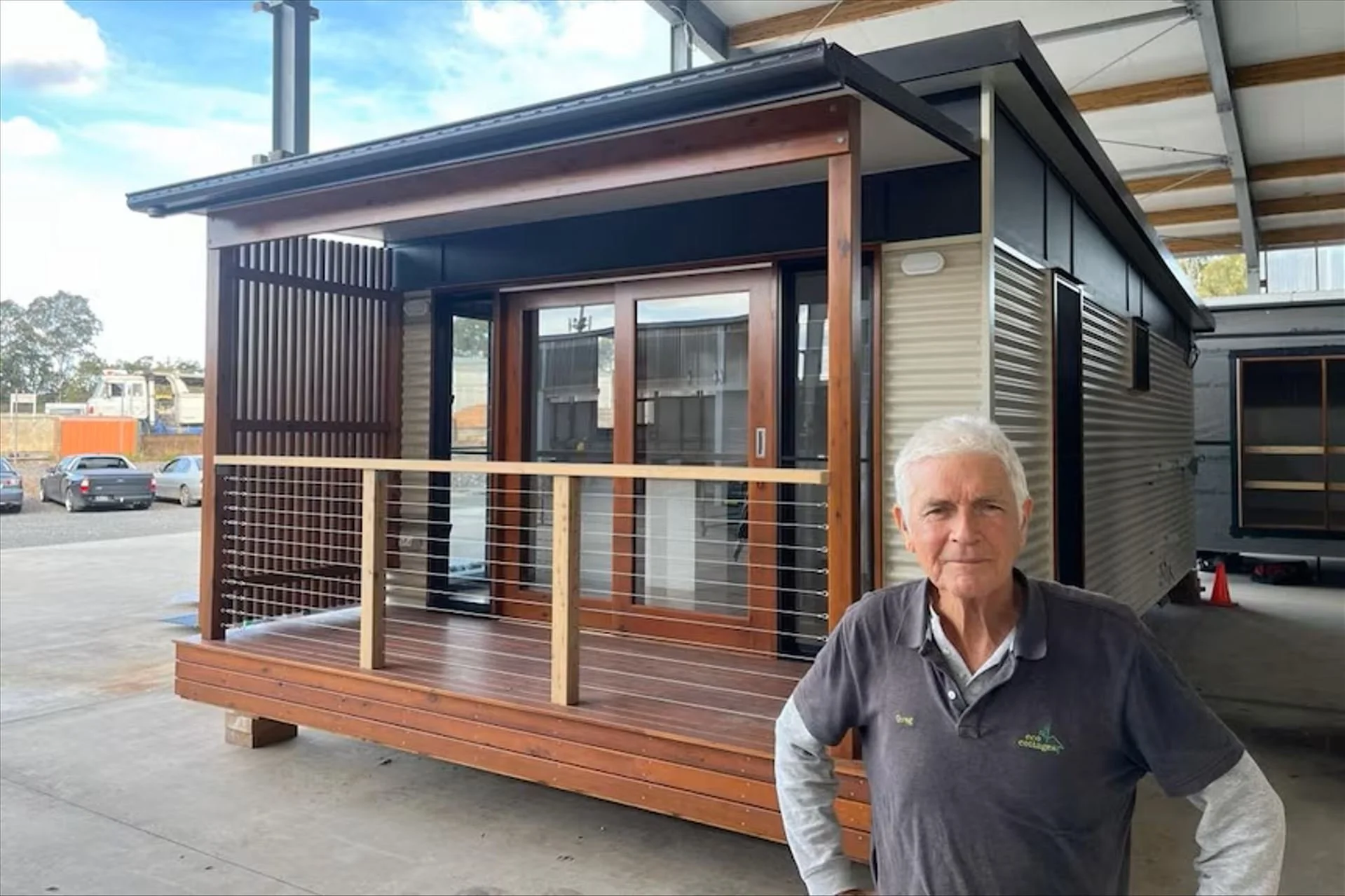
Circular Economy prefab workshop using native cypress pine: Greg Phipps, late director of Eco Cottages, Cooroy QLD.
Source: ABC article, photo provided by Greg Phipps
Last week we presented at Timber Queensland’s ‘From Forest to Framework’ Roma event on Eco Cottages’ Circular Economy prefab model, following our work with the late director Greg Phipps. The event highlighted local forest product innovations and other opportunities emerging from the recently released Queensland Future Timber Plan; a 25-year strategy aligning sustainable supply with construction, bioeconomy and infrastructure demand. Greg was an inspiration for many through his advocacy for social housing and stewardship of native cypress pine.
In this article, we share how Circular Economy principles were implemented in Eco Cottages’ factory and practical steps building owners can take today towards this standard, thereby live healthy and reduce construction cost.
Key facts in Australia
Australia has ambitious targets, yet we are a long way from escaping the linear take-make-dispose model. More builders are tackling the incredible volume of construction waste, as the industry is the single largest source of waste with 39% of Australia’s total waste output (CEFC, 2025). To put this into perspective, a national report by the Green Building Council found that the average building project wastes 141 kg of material/m2, risking $64 billion lost over the next five years. Up to 22% of materials for multi-residential buildings never make it into the final building, resulting in an estimated $52,000 in lost value per apartment for developers and owners (GBCA, 2025).
Less waste = less construction cost
Many of the most wasted materials are high-cost and high-impact; the report found concrete, masonry and tiles make up the largest volume of waste, followed by excavated soil, timber offcuts, metals and plasterboard. These are typically over-ordered, mishandled or discarded during installation (GBCA, 2025) – better planning and procurement directly saves money for your project.
Working towards a circular economy
Australia’s circularity rate is as low as 4.6% with the target to double by 2035 (DCCEEW 2024), well below leading countries such as the Netherlands (24.5%). The three circular economy principles - driven by design - are defined by the Macarthur Foundation:
1. Eliminate waste and pollution
2. Circulate products and materials (at their highest value)
3. Regenerate nature
Transitioning to a circular economy requires refining regulations, policies and processes. This collaborative effort starts with design thinking - Eco Cottages’ achievements show that buildings can even contribute to regenerating nature.
Eco Cottages’ Circular Economy prefab model
Eco Cottages’ legacy is a result of the director’s 30 years R&D and a strong foundation to build upon, with opportunities emerging from the Queensland Future Timber Plan. The companies’ innovative work was documented in a book chapter in ‘Sustainability and Toxicity of Building Materials’, which suggests extending the 17 UN Sustainable Development Goals based on Eco Cottages’ four principles:
1. Non-toxicity of materials & products
2. Net energy costs & GHG in manufacture
3. Embodied carbon measure
4. Circular economy principles
Eco Cottages delivered all three of the Macarthur Foundation’s Circular Economy principles (Matthews, 2024):
1. Design out waste and pollution
• Factory efficiency: close to 100% resource use
• Native local cypress: termite resistant / chemical-free, low embodied carbon, carbon sequestration
• Offcuts used for floor trusses, glulam, joinery
• Non-toxic timber finishes & glulam adhesives
• Net zero PV manufacturing. pre-installed solar
2. Keep products and materials in use
• Flexible, adaptable and relocatable homes
• Cypress is strong, durable (class 1, above ground) and moisture/mould resistant
• Engineered Wood Products (EWPs) - efficient resource use, designed for reuse/recycling
3. Regenerate natural systems
• Cypress stewardship: improved selective harvesting regenerates biodiversity
• Abundant stands, currently under-utilised and under-valued
• Drought resistant, grows on low-rainfall land,, improves soil and reduces runoff
• Endangered species protection, e.g. koala daytime shelter
We will share more information about cypress and other under-utilised native timbers. You can read some thoughts about modular/prefab construction in Australia here
Practical steps you can take today
While each project and circumstances are different, some key considerations to minimise waste and save construction cost are:
Retrofit existing buildings where possible/viable as more sustainable option
Efficient design: practical building size and layout, flexible spaces, future adaptability, standard material sizing to minimise offcuts
Engage qualified architect / designer and builder early for optimal value and collaboration
Design for longevity of materials and structures
Prioritise durable and/or renewable, low-zero toxic, non-composite materials to facilitate future recovery and reuse
Support local supply chains and ethical sourcing
Consider whether modular design and prefab construction suit your project
Design and cost outcomes are set at the concept stage. Net Zero Design supports early decisions by discussing your motivations and preferences, with builder input where relevant.
Considering circular economy principles? Schedule a free 30min online meeting to discuss how this fits your family or business.
References
DCCEEW (2024), Australia’s Circular Economy Framework, Department of Climate Change, Energy, the Environment and Water, Canberra, December. CC BY 4.0
Coreo and Green Building Council of Australia (2025) Australia's waste[d] Opportunity 2025: Benchmarking report. Green Building Council of Australia
Matthews, J. (2024). ’Eco cottages: using local indigenous nontoxic renewable cypress resources for sustainable construction and production’ in ‘Sustainability and Toxicity of Building Materials’, Woodhead Publishing, pp. 481-495, https://doi.org/10.1016/B978-0-323-98336-5.00022-4.