
Cypress Pine: An abundant native resource for healthy, non-toxic buildings
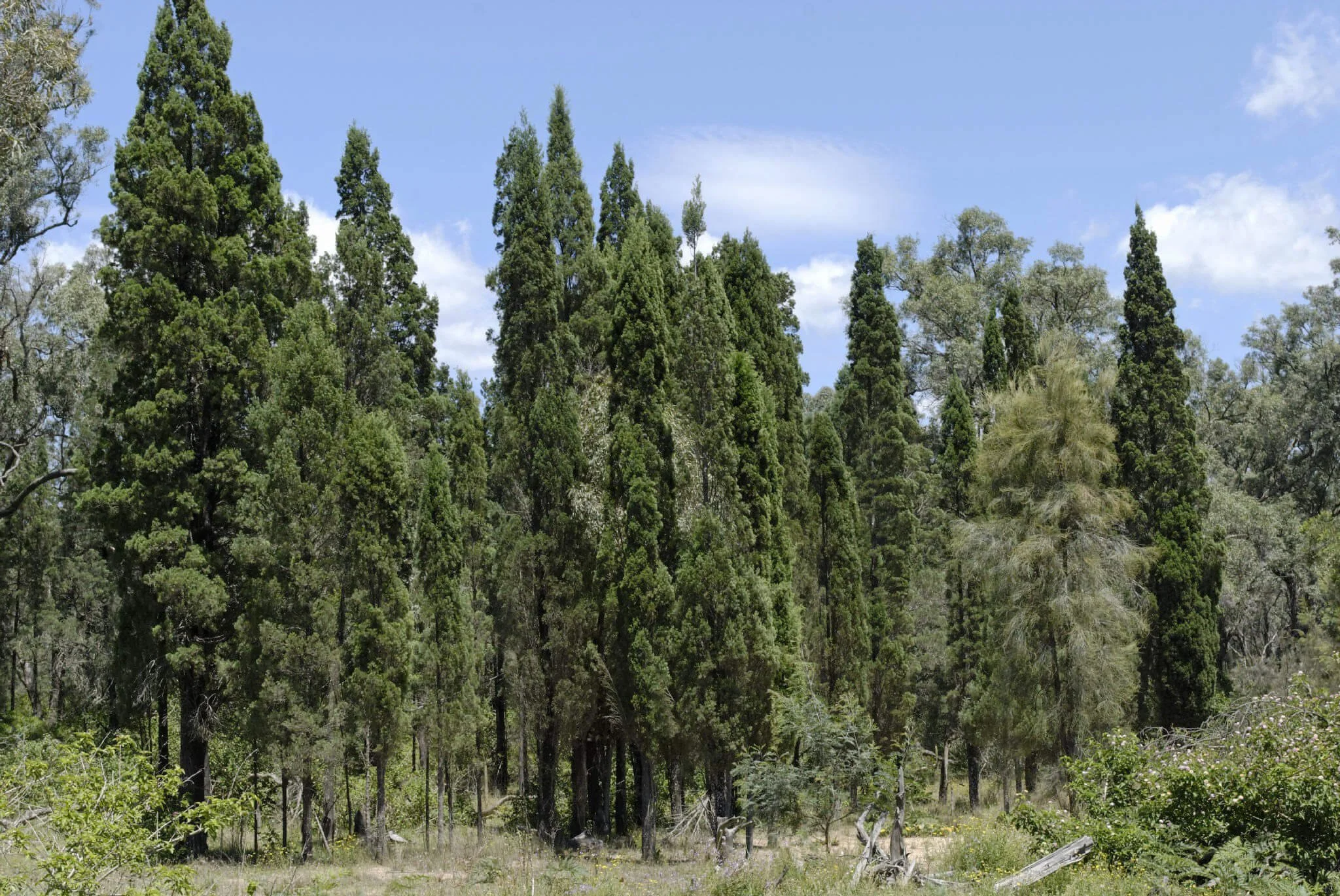
White cypress pine (Callitris glaucophylla), Photo by Tony Rodd
Source: Grasslands: Biodiversity of south-eastern Australa
Australia is fortunate to be home to beautiful timber species that make attractive features in your building and are also a vital part of our natural environment. This article outlines the many unique properties of a native, abundant species: White Cypress pine (Callitris Glaucophylla), and how these can improve people’s and ecosystem health.
Our appreciation of cypress stems from collaboration with an innovative manufacturer whose life’s work over three decades was a circular economy prefab factory (Eco Cottages – read about the model here).
Why local timber?
Many people find natural wood creates spaces that are calming and inviting, contributing to a healthier and happier living environment. The long-term demand for timber is projected to grow, with an expected 50% market gap in construction by 2050 (ABARES, 2025). Using local timber has many advantages: better supply security, control over ethical sourcing, less transport cost, import independence and local job creation, to name a few.
Timber supply in Queensland makes up 82% sawlogs from softwood plantations, 11% hardwood from selectively harvested state forests and 7% from plantations. High-value ecosystems need better protection, however improved silvicultural management in suitable areas has been widely proven to increase timber productivity as well as biodiversity. Cypress is a strong example to show how this can benefit both forest health and the economy.
White Cypress Pine - Historic and current use
Cypress pine is a durable native softwood with a long history in the Australian construction industry. It lost its market share in framing with introduction of exotic softwood plantations, mainly due to poor marketing and limited guidelines on optimal growth. Existing cypress structures are still robust after many decades.
Prior to European settlement, white cypress often occurred in mixed woodland communities with an important role for maintaining essential ecosystem functions (Thompson & Eldridge, 2005, Eco Cottages, 2023). Large-scale tree clearing, selective removal of associated eucalypts and other species, harvesting, grazing and control/exclusion of fire has resulted in dominating stands in many parts. These are often in a dense, ‘locked-up’ condition where trees are in intense competition with very low or nil growth. As a result, silvicultural management is essential which was reported not to be viable without commercial use (e.g. IFA NSW, 2013).
Cypress pine use in Australian buildings is less than 2% despite its abundance and wide geographic distribution. It is used for durable structural framing, more recently glulam and retains a strong niche in flooring, cladding and decking (30%). The breakdown below from a recent Timber Queensland/DPI hosted forum in Roma shows the potential for higher value use as the remaining 70% are used in landscaping and fencing:
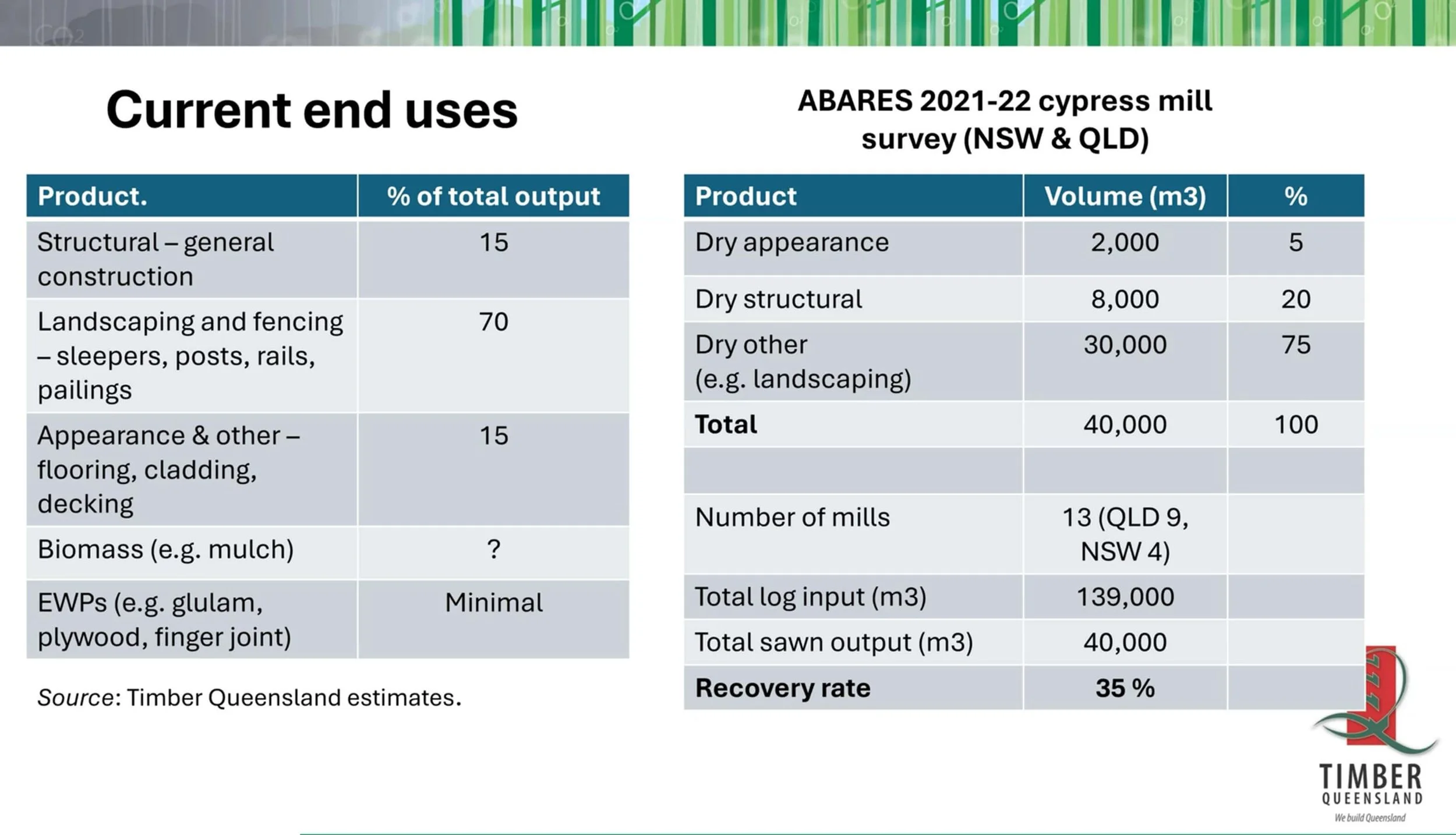
White Cypress Pine use, Source: ‘From Forest to Framework’ Roma event, 20 Nov. 2025
hosted by Timber Queensland & Department of Primary Industries, Queensland (DPI)
Cypress unique properties
This native Australian softwood has many unique properties, making it suitable for a wide range of internal and external uses. One of its key advantages is natural termite resistance - it does not require chemical treatment and is a non-toxic building material. Recent processing technology advances now enable significantly higher timber recovery in abundant stands while improving forest health through selective harvesting. Using cypress in your building is a holistic sustainable choice:
• Durability and strength - naturally durable (Class 1 above-ground / Class 2 in-ground), F7 structural grade, high tensile strength, low shrinkage, easy to work.
• Natural termite resistance - the only chemical-free Australian softwood, reducing toxins in your home and environmental impact.
• Natural beauty - distinctive structure and differing tones give cypress a warm, organic character valued for appearance grade applications.
• Moisture resistance - natural resins and oils with antifungal properties improve durability and minimise condensation / mould risk with appropriate design, a key issue in Australian buildings.
• Drought resistance – strongly adapted to dry environments, cypress grows on low cost, low rainfall land of min. 250mm/yr, therefore in less competition with agriculture than plantations
• Reduced soil erosion through selective harvesting and biological soil crusts, i.e. symbiosis with ground cover species and soil stabilising organisms.
• Carbon sequestration – strong potential under good management due to prolific growth, with potential for carbon credits as extra incentive for landowners.
• Biodiversity restoration – Extensive biodiversity and habitat surveys found many positive relationships between sustainable cypress management and species diversity (DPI, NSW 2018), including koalas in mixed forests which use cypress for daytime shelter.
From a construction point of view, cypress can improve building physics through good thermal performance, fast drying ability and moisture resistance. Yet it is suitable for breathable construction with moderate vapour permeability and indoor climate regulation.
For homeowners looking for holistic sustainability, building with cypress not only creates a non-toxic, durable home but can also support native species habitat and climate resilience - reducing your ecological footprint while enhancing biodiversity in the region.
Future potential
Cypress and native Australian plantation timbers are under-utilised despite their value. New advanced processing and emerging Engineered Wood Products (EWPs) allow up to 60% more timber to end up in your building that has been wasted or downgraded. Cypress has proven value in glulam beams, an industrial plywood trial, LVL lab tests and mixed species bridge girders.
No commercial scale cypress plantation exists to date, however long-term this could help to restore degraded land. A feasibility study identified large areas of suitable land not viable for agriculture.
Immediate action is possible through policy reform - the Queensland Future Timber Plan is a 25-year strategy to secure sustainable timber for one million homes by 2044 via expanded plantations and improved selective native harvesting, positioning abundant cypress stands as a key resource.
Whether you're renovating as a homeowner, developing prefab projects or building with non-toxic priorities, discover how cypress can elevate your sustainable design. Reach out for a free 30-minute phone or online meeting to discuss your healthy building project.